


A soft serve machine that’s underpowered for your peak serving volume is one of the more frustrating pieces of equipment a food service business can own. It creates queues, slows service, and produces a product that’s inconsistent in temperature and texture when the machine hasn’t had time to recover between portions. Getting the capacity right from the start saves both the aggravation and the cost of replacing equipment before it has paid itself off.
Floor-standing models with a compressor cooling system are the standard for high-volume operations. They recover quickly between portions, can serve multiple flavours from separate cylinders, and handle extended service periods without temperature loss. These are the machines you see in fast food outlets, amusement parks, and busy cafes.
Countertop soft serve units are designed for lower volume applications, cafes with limited floor space, or operations where soft serve is a supplementary rather than primary menu item. They have smaller cylinder capacities and slower recovery times than floor models, which limits their throughput but makes them suitable for moderate demand.
Gravity-fed and pump-fed configurations differ in how the mix is delivered to the freezing cylinder. Pump-fed machines control mix flow more precisely, which affects texture consistency. Gravity-fed models are simpler mechanically and easier to clean, which suits operations where cleaning frequency and simplicity of maintenance are priorities.
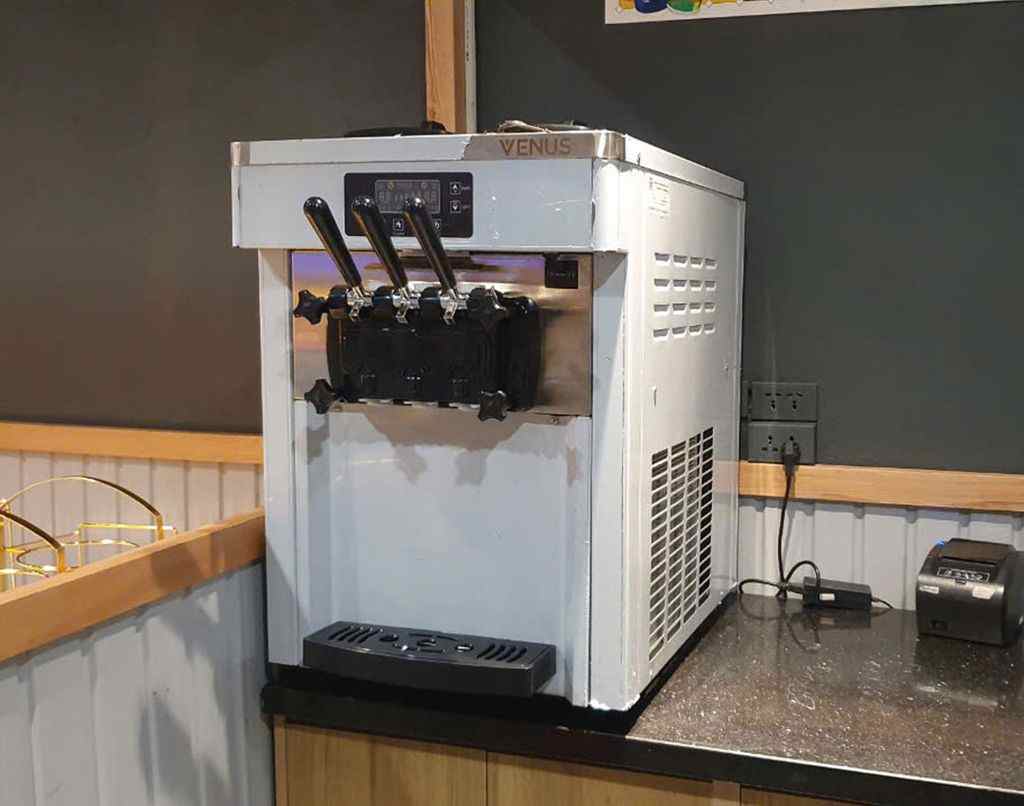
The only way to accurately specify capacity is to estimate the number of portions you’ll sell in your busiest hour and match the machine’s rated throughput to that demand with a safety margin. A machine rated for 40 portions per hour running at consistent 90% capacity during a two-hour peak period will produce a better-quality product than one rated for the same output but running at 100% with no recovery time.
Ice cream machines for commercial use are rated in litres per hour of mix throughput. Convert your expected portion size and hourly demand into litres to get a figure that can be matched against the machine specification. Most manufacturers provide this throughput figure, and your supplier should be able to help you calculate the right capacity for your specific application.
Daily cleaning of the freezing cylinder, beaters, and mix delivery components is a food safety requirement, not an optional extra. Machines that are difficult to disassemble for cleaning tend to get cleaned less thoroughly, which creates both a hygiene risk and a flavour quality problem as residual mix builds up in hard-to-reach areas.
Compressor servicing is the key mechanical maintenance item. The compressor is what drives the machine’s ability to freeze the mix rapidly and consistently. An annual service by a qualified refrigeration technician keeps the compressor performing at specification and extends the useful life of the machine significantly beyond what unserviced equipment achieves.
Do I need a single or twin cylinder soft serve machine?
A twin cylinder machine allows you to serve two different flavours (typically chocolate and vanilla) plus a twist option combining both. If your menu offers multiple soft serve flavours or if you want the visual appeal of the twist option, a twin cylinder is the right choice. Single cylinder machines are adequate if you’re offering one consistent flavour and want a simpler, lower-cost machine to maintain.
What power supply does a commercial soft serve machine require?
Most floor-standing commercial soft serve machines require a 15-amp or 20-amp single-phase supply. Some larger models require a three-phase supply. Confirm the power requirements before purchasing and check that the intended installation location has the correct power outlet available. Installing the wrong outlet after the machine arrives adds cost and delays getting the equipment into service.
How often do soft serve machine seals and O-rings need replacing?
Seals and O-rings are consumable parts that should be inspected during each daily clean and replaced as soon as any wear, cracking, or leaking is noticed. A worn seal allows mix to bypass the beater, which affects both portion yield and hygiene. Most manufacturers publish a recommended replacement interval, typically every three to six months for machines in daily commercial use, which serves as a baseline regardless of visible wear.




Comments are off for this post.